Updated September 2026
Pet Import ServicePet Import Services in Dubai
Commercial import into the UAE: we sequence the MOCCAE permit (90 days from issuance), the titre certificate when the origin is high-risk, cargo into…
General guidance is free in the guides. Bespoke document review and coordination are paid.
Direct answer
What are the requirements for traveling with my pet to the UAE?
A pet entering the UAE needs a permanent microchip whose number matches the health certificate, the vaccines for that species, an authorised health certificate, and a MOCCAE import permit valid 90 days from issuance. High-risk origins add a rabies antibody test of at least 0.5 IU/ml. Matching animals are inspected and released. Full rules live on the UAE import-requirements guide.
What this import service covers
Import coordination means we sequence the paid file: partners, paperwork and clearance. The full statutory checklist lives on UAE pet import requirements. Arrival-side settling (first week, municipality registration) lives on pet relocation to Dubai. Permit filing as a standalone product lives on MOCCAE permit assistance.
If you are paying someone to get a dog or cat into the UAE, the work is operational: eligibility, document sequence, a permit that is still valid on landing, a cargo booking, veterinary inspection at the cargo village, and last-mile handover. We coordinate that sequence with veterinary and transport partners. We do not operate the aircraft. Only MOCCAE issues permits.
Emirates says ordinary pets are not in the cabin, and itineraries ending in Dubai must travel as cargo. Country corridors belong on the routes hub.
- Eligibility review against the ban list printed on the MOCCAE import page
- Document pack: matching microchip, species vaccines, antibody test only if the origin is high-risk
- MOCCAE import permit timed to the 90-day validity window
- IATA crate sizing and manifested cargo booking into DXB, DWC or AUH
- Arrival inspection coordination and door delivery in Dubai
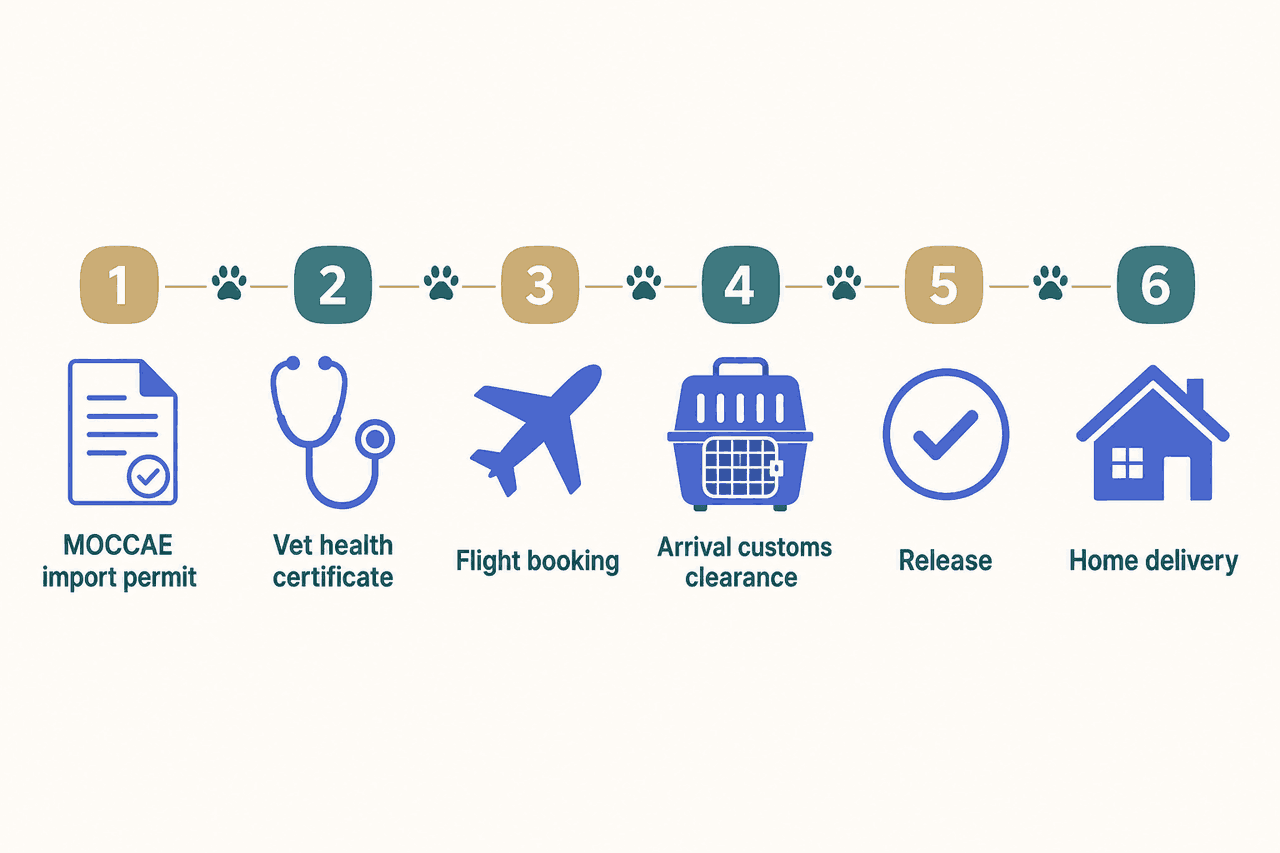
The six-stage import sequence we actually run
Book cargo only after the permit window and, for a high-risk origin, the titre certificate are understood.
Eligibility and origin check
Send breed, age, weight, origin country and a target month. We check the published ban list. We do not reprint the low-risk country list. On 22 September 2026 the United Kingdom was on it and the United States was not named on it. Confirm any other origin on the live page.
Microchip and vaccines
Permanent microchip. The number on the health certificate must match the animal. ISO 11784/11785 and an implant-before-vaccine order were not restated on the live page. Rabies vaccination is not before 12 weeks of age. Dogs also need distemper, parvovirus, infectious canine hepatitis and leptospirosis. Cats need panleukopenia, rhinotracheitis and calicivirus.
Antibody test, only if the origin is high-risk
High-risk origins need at least 0.5 IU/ml. The certificate is valid for 365 days if the vaccine stays valid and continuous and no booster is given. Otherwise the test is repeated. A first vaccine, or a gap in vaccination, needs at least 21 days before the test. A valid booster does not. An older 90-day sample window is not on the live page. Detail: rabies titre test for Dubai.
MOCCAE import permit, 90 days from issuance
MOCCAE import permits are valid for 90 days from the date of issuance. The pet must enter the UAE within that window. It is not allowed to import pets with an expired import permit. On 22 September 2026 the MOCCAE page listed AED 200 to issue an import permit for one animal, AED 500 to release one dog, and AED 250 to release one cat. These are government charges, not a relocation package. The published estimate is 1 working day, or 5 working days for a service, emotional support or medical dog. Walkthrough: how to apply for a MOCCAE import permit. Hands-on filing: MOCCAE permit assistance.
Health certificate, parasites, crate and cargo
The live page asks for an authorised health certificate and does not state a universal 5-day or 10-day validity. Internal and external parasite treatment is recorded in the 14 days before shipment. Your vet chooses a species-safe product. We size an IATA crate and coordinate cargo. Emirates itineraries ending in Dubai are cargo.
Clearance at DXB / AUH and door delivery
On 22 September 2026 the MOCCAE page listed AED 200 to issue an import permit for one animal, AED 500 to release one dog, and AED 250 to release one cat. These are government charges, not a relocation package. A MOCCAE inspector checks the chip and the file. If the import does not comply, the pet may be rejected at the owner's expense or confiscated. The page does not publish a fine amount. A matching animal is examined at the entry port and released. No routine quarantine length is published. We arrange last-mile delivery and keep you on WhatsApp during business hours. We do not promise a release time.
Documents we line-check before anything is booked
This is a commercial review list, not a substitute for the statutory table on the requirements guide. Every certificate must show the same 15-digit microchip number.

- Permanent microchip. The health-certificate number must match the animal. ISO was not restated.
- Rabies vaccination not before 12 weeks of age. Validity follows the manufacturer.
- Species vaccines as listed on UAE pet import requirements
- Antibody result of at least 0.5 IU/ml when the origin is high-risk, under the 365-day certificate conditions
- Authorised health certificate from the origin authority. No universal 10-day validity on the MOCCAE page.
- MOCCAE import permit still inside its 90 days from issuance on the arrival date
- Internal and external parasite treatment in the 14 days before shipment
- Release papers: customs declaration or bill of lading, vaccine record, health certificate, and the antibody certificate if required
If the import does not comply, the pet may be rejected at the owner's expense or confiscated. The page does not publish a fine amount. A matching animal is examined at the entry port and released. No routine quarantine length is published. We check the pack before the flight.
How we time the 90-day MOCCAE permit against the flight
The permit is the legal gate. Airlines will not accept the animal without it, and a cargo village will not release an animal on an expired permit. The commercial job is to issue it late enough to cover landing and early enough to survive processing.
MOCCAE import permits are valid for 90 days from the date of issuance. The pet must enter the UAE within that window. It is not allowed to import pets with an expired import permit. Applying the day you first think about moving is how permits expire on the tarmac. We work backwards from a confirmed cargo date, then open the portal application once the document pack is consistent.
Access uses the MOCCAE digital account. We still do not issue the permit. MOCCAE does. Individuals may import up to 2 companion animals per person in the year (2 cats, 2 dogs, or 1 of each), except resident animals returning.
The published permit estimate is 1 working day, or 5 working days for a service, emotional support or medical dog.
What sets the calendar
There is no single week count. It depends on whether the origin is high-risk, and on the vaccine already in the animal.
When the origin is low-risk and the animal is already microchipped and vaccinated, the tight clocks are the 90-day permit, parasite treatment in the 14 days before shipment, and the origin health certificate's own validity. We do not promise a 4 to 6 week file.
High-risk origins need at least 0.5 IU/ml. The certificate is valid for 365 days if the vaccine stays valid and continuous and no booster is given. Otherwise the test is repeated. A first vaccine, or a gap in vaccination, needs at least 21 days before the test. A valid booster does not. An older 90-day sample window is not on the live page. Clinic turnaround is not a Ministry service time. We map the certificate against the permit, which lasts 90 days from issuance.
| Starting point | What usually drives the calendar | What we will not claim |
|---|---|---|
| RNATT not required; already vaccinated | Health certificate + 90-day permit + cargo slot | A guaranteed week count. Cargo calendars move. |
| RNATT not required; new rabies vaccine | 21 days before the antibody test only if the vaccine is a first dose or follows a gap | That every pet must wait 21 days before arrival |
| Antibody test required | 0.5 IU/ml and the 365-day certificate conditions, then the 90-day permit | A 90-day sample window or a 90-day wait after the result |
What an import quote is made of
This page does not publish a package total. The government amounts below are the fees on the MOCCAE page checked on 22 September 2026.
On 22 September 2026 the MOCCAE page listed AED 200 to issue an import permit for one animal, AED 500 to release one dog, and AED 250 to release one cat. These are government charges, not a relocation package. Those amounts exclude origin veterinary work, the crate, cargo and coordination. We do not publish a package total.
| Cost type | How we treat it on this page |
|---|---|
| MOCCAE import permit (per animal) | AED 200 on the page checked 22 September 2026 |
| Dog release / cat release | AED 500 per dog, AED 250 per cat, on that same page |
| Origin veterinary (vaccines, certificate, titer if required) | Quoted from your origin vet — not a published DPR fee table |
| IATA-compliant crate | Sized to the animal; partner quote, not a guess from a chart |
| Manifested cargo | Airline and route specific — we itemise before you book |
| Coordination and handling | Quoted on WhatsApp for your origin, size and service tier |
Compare how much of the sequence we hold versus how much you hold on compare our service tiers. Then send origin, pet and month on WhatsApp for a paid eligibility check and a managed-import quote — we do not publish a fake AED total on this page. Packages: Prices.
Breed eligibility before you spend on cargo
We check the dog against the ban list printed on the MOCCAE import page before you commit to a flight.
The names on that page include Staffordshire Bull Terrier, American Pit Bull Terrier, American Staffordshire Terrier, American Bully, the listed mastiff types, Japanese Tosa and Presa Canario. Rottweiler, Doberman and Boxer were not on the list we checked. The English page does not add "any cross", so this page does not either. Full names: banned dog breeds in Dubai.
The same page allows service, emotional support and medical dogs when a certified training-centre document, a certified medical report on the owner, and a signed pledge are supplied. A casual letter is not those documents.
Airport clearance we coordinate — DXB, DWC and AUH
Pets enter as manifested cargo, so they arrive at a cargo terminal, not the passenger hall. This section stays a short commercial summary. The full post-arrival journey — DXB arrival, clearance and registration — lives on the Dubai pet arrival guide.
At Dubai International the typical path is the cargo village: inspection, microchip check against the permit, document review, then handover. On 22 September 2026 the MOCCAE page listed AED 200 to issue an import permit for one animal, AED 500 to release one dog, and AED 250 to release one cat. These are government charges, not a relocation package. If the import does not comply, the pet may be rejected at the owner's expense or confiscated. The page does not publish a fine amount. A matching animal is examined at the entry port and released. No routine quarantine length is published. Step-by-step notes are on the Dubai pet arrival guide.
Abu Dhabi arrivals use the same federal permit. The Etihad product page was not fully re-read on 22 September 2026, so this page does not repeat cabin weights, fares or a bill-of-entry amount. Confirm the carrier in writing.
If the import does not comply, the pet may be rejected at the owner's expense or confiscated. The page does not publish a fine amount. A matching animal is examined at the entry port and released. No routine quarantine length is published. We stay on the thread until the animal is in the van. We do not promise a clearance time.
Frequently Asked Questions
Official Sources
We coordinate the paperwork, but the rules are set by government and industry authorities. Always confirm the current requirements directly with the official sources.
Last verified: 6 September 2026. Confirm current figures on the official MOCCAE portal before you apply.
Ready to book a managed move?
WhatsApp during business hours with pet type, breed, route and month if you want us to run the file. Guides stay free to read.
Get a managed-move quoteGeneral guidance is free in the guides. Bespoke document review and coordination are paid.