Updated September 2026
Pet Relocation ServiceCat Relocation Dubai
Moving a cat to or from Dubai?
General guidance is free in the guides. Bespoke document review and coordination are paid.
Cat Relocation Across Dubai and Worldwide
Cats are creatures of territory and routine, so a move affects them differently from a dog. Our cat relocation service is built around keeping a sensitive animal as calm as possible while meeting every legal requirement to enter or leave the UAE.
Cat relocation in Dubai spans two kinds of journey. The first is a local or inter-emirate move — a quiet, climate-controlled ground transfer within Dubai or between emirates such as Dubai to Abu Dhabi or Sharjah. The second is international relocation by air, either importing a cat into the UAE or exporting one out of it. In both cases the foundations are the same: an ISO-compliant microchip, a valid rabies vaccination, a government health certificate and, for flights, a correctly sized travel carrier your cat is comfortable in.
We are a coordination service. We do not physically fly the animals ourselves; we connect you with vetted veterinary and transport partners, confirm your cat is document-ready, and make sure the paperwork, carrier and flight line up. For the full cross-species picture, see our main pet relocation in Dubai page. The sections below focus on what matters specifically for cats: why they travel differently, how to acclimate the carrier, why sedation is discouraged, the documents and timeline, and cost.
- Low-stress local and inter-emirate transport in a quiet, climate-controlled vehicle
- International import and export coordination with cat-experienced airlines
- Carrier sizing, acclimation guidance and pre-travel preparation
- Microchip, rabies vaccination and health-certificate timeline mapped to your travel date
- MOCCAE import or export permit guidance for moves to or from the UAE
- Customs clearance at DXB or DWC and gentle door-to-door delivery anywhere in Dubai
Why Cats Travel Differently
Understanding feline behaviour is the difference between a smooth move and a frightened cat. Almost everything we do for cats is shaped by how strongly they bond to place rather than to journeys.
Cats are territorial animals that take comfort from familiar smells, surfaces and routine. Unlike many dogs, they rarely enjoy car rides, do not see a carrier as a fun outing, and become stressed by unfamiliar noise, motion and handling. They also hide discomfort well, so a cat can be far more anxious than it looks. This is why a successful cat move depends less on logistics horsepower and more on patience, gentle handling and reducing novelty wherever possible.
Practically, this changes how we plan. Small cats may be eligible to travel in the aircraft cabin with their owner on some airlines and routes, which is usually far less stressful than cargo — we check whether your cat qualifies on weight and whether your route allows it. Where cabin travel is not possible, cats fly as manifest cargo in the same temperature-controlled, pressurised hold area used for dogs, but we focus on a quiet carrier, a familiar-smelling blanket and minimal transfers. We also pay close attention to settling-in after arrival, because cats commonly show behavioural changes — hiding, reduced appetite or over-grooming — in the first days in a new home.
- Cats bond to territory, so the goal is to carry their familiar environment with them as much as possible
- They hide stress, so calm preparation matters more than reacting on the day
- Small cats may qualify for in-cabin travel on some airlines — gentler than cargo, so we always check eligibility
- Where cargo is required, the hold is temperature-controlled and pressurised, the same area dogs use
- Expect a settling-in period after arrival; a familiar litter tray, bedding and a quiet room help enormously
Carrier Acclimation Tips
The carrier is the one part of the journey you can fully prepare in advance. A cat that already sees its carrier as a safe den will travel far more calmly than one that meets it for the first time on travel day.
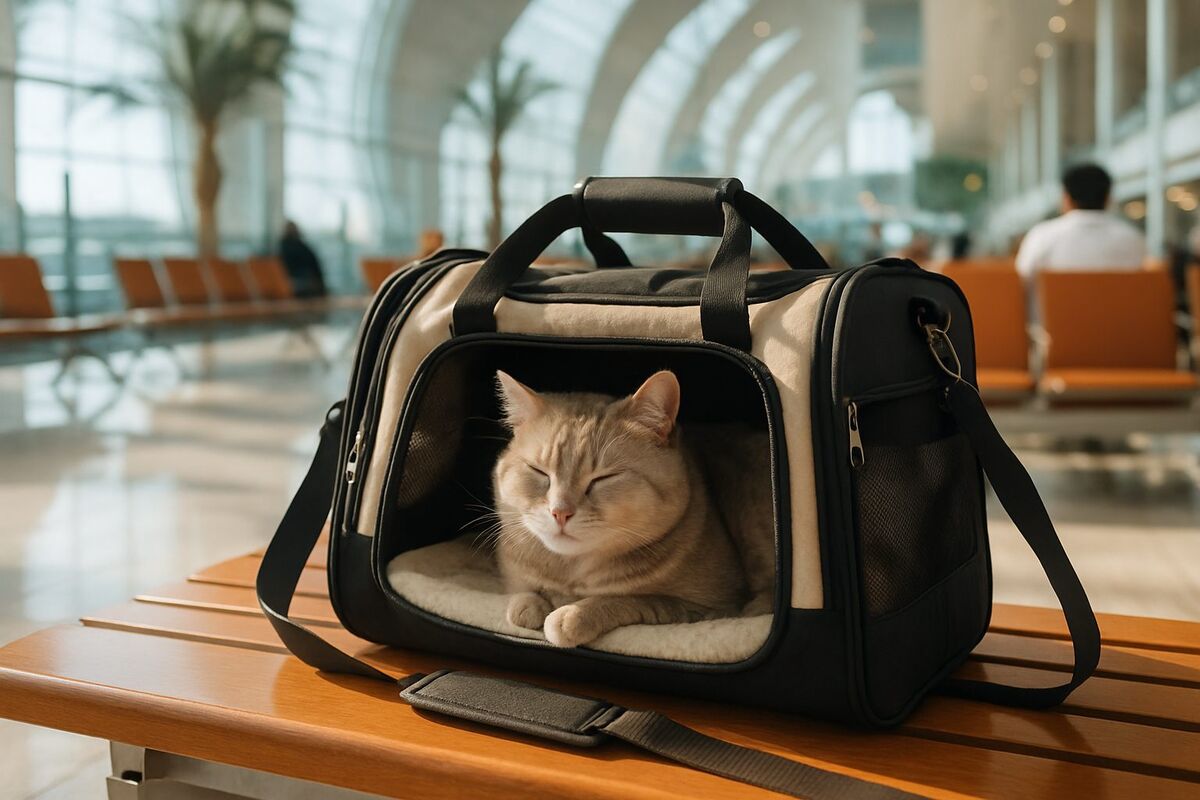
Start carrier acclimation two to four weeks before travel, ideally earlier. The aim is to turn the carrier from a once-a-year vet-trip object into an everyday piece of furniture your cat chooses to rest in. Combined with a correctly sized carrier — large enough to stand, turn and lie down, rigid and well-ventilated for cargo, or an airline-approved soft carrier for cabin travel — this is the single most effective thing an owner can do to reduce travel stress.
- Bring the carrier out early and leave it open in a room your cat already likes, weeks before travel
- Line it with bedding that smells of home, and add a worn t-shirt or familiar blanket
- Feed treats and meals near, then inside, the carrier so it becomes associated with good things
- Let your cat enter and leave freely; never force it in or only produce the carrier for vet visits
- Use a feline calming pheromone spray on the bedding (not the cat) to add a reassuring scent
- Take a few short, calm practice car trips so motion and the carrier together feel familiar
- On travel day, keep handling quiet and minimal, and avoid opening the carrier in transit
For cargo travel the carrier must meet the IATA Live Animals Regulations — rigid, ventilated on at least three sides, secured with metal bolts and fitted with water access. We size and source the right carrier through our vetted partners and give you the acclimation plan early so your cat has time to make it home.
Sedation: Why Most Vets and Airlines Advise Against It
It is natural to want to spare an anxious cat the experience by sedating it. In reality, veterinary and airline guidance is clear that sedation usually makes air travel more dangerous, not less.
Major veterinary and airline bodies, including guidance reflected by the IATA Live Animals Regulations and the American Veterinary Medical Association (AVMA), advise against sedating cats and dogs for air travel except in rare cases on the explicit instruction of a veterinarian. The reason is physiological: at altitude, cabin and cargo-hold air pressure is lower than at ground level, and sedatives can depress breathing and heart function, impair the animal’s ability to balance and brace against turbulence, and interfere with its natural temperature regulation. A sedated animal that cannot right itself or breathe efficiently is at far greater risk than a stressed but alert one.
Because of this, many airlines will refuse to accept an animal that appears sedated, and some require written confirmation that no tranquilliser has been given. The safer path is to manage stress without drugs: thorough carrier acclimation, a familiar-smelling blanket, feline calming pheromones, choosing cabin travel for eligible small cats, and a calm, well-planned route with minimal transfers. If your cat has a specific medical condition, that is a conversation for your own vet, who can weigh the individual risks — but as a default, a relocated cat should travel awake and unsedated.
- IATA and AVMA guidance: do not sedate pets for air travel except on a vet’s specific instruction
- Lower cabin pressure at altitude makes sedatives riskier, affecting breathing, heart rate and balance
- Sedated animals cannot brace against turbulence or regulate temperature well
- Many airlines refuse sedated animals and may ask for written confirmation none was given
- Manage stress instead with acclimation, familiar scents, pheromones and a calm route
Cat Documents & Timeline
Cats and dogs share the same core entry requirements for the UAE. The work is in the timing — vaccinations and tests have minimum waiting periods, so we plan the calendar backwards from your travel date.
Every cat needs an ISO-compliant 15-digit microchip implanted before — or at the same time as — its rabies vaccination, because the rabies record must link to the chip number. A current rabies vaccination is mandatory and is generally required at least 21 days before travel while still being in date. Cats usually also carry their core FVRCP vaccination. For cats arriving from countries the UAE classifies as high-risk for rabies, a rabies antibody titer test is required: the blood is drawn at least 21 days after vaccination, must show a result of at least 0.5 IU/ml, and a further waiting period applies before the cat can travel — which is what extends some imports to around four months.
- ISO 11784/11785 15-digit microchip — implanted before or with the rabies shot
- Valid rabies vaccination — generally at least 21 days before travel and still in date
- Core FVRCP vaccination recorded in the vaccination booklet
- Rabies antibody titer test for high-risk countries — drawn 21+ days post-vaccination, result greater than or equal to 0.5 IU/ml, valid 365 days
- Government veterinary health certificate from the origin country, issued close to travel
- MOCCAE import permit (valid 90 days from issuance) for entering the UAE, or an export certificate for leaving
As a rough guide, a cat moving between two low-risk countries can often be ready in two to six weeks, while a cat from a high-risk country that needs a titer test should plan for around four months. We build your exact timeline against your origin, destination and travel date, and verify every requirement against the current MOCCAE rules before you commit to flights.
Cat Relocation Cost
Cats are lighter than most dogs and can sometimes travel in the cabin, so cat relocation tends to sit at the gentler end of the price range — though long-haul international moves still carry real freight and veterinary costs.
Total cat relocation typically ranges from about AED 2,000 for a simple regional move to AED 18,000 for a long-haul international flight with full door-to-door service. Because cats and their carriers are light, air freight is usually lower than for a large dog, and an eligible small cat travelling in the cabin can reduce cost further. Government permit fees are modest; most of your budget is veterinary work, the carrier, the flight and coordination.
| Cost component | Typical range (AED) |
|---|---|
| MOCCAE permit + release fees | 450 – 700 |
| Veterinary (microchip, vaccines, health cert, titer) | 1,100 – 2,500 |
| IATA carrier (cabin soft carrier to cargo crate) | 110 – 900 |
| Flight / cargo (cabin or hold, route dependent) | 1,500 – 10,000+ |
| Coordination & door-to-door handling | 1,200 – 5,000 |
In-cabin eligibility, route and whether a titer test is needed all move the final figure, which is why we quote against your specific cat and journey rather than a flat price. Send us your cat’s origin, destination and travel date on WhatsApp and we will return a clear cost range, usually within fifteen minutes during business hours.
Related Services & Guides
Frequently Asked Questions
Official Sources
We coordinate the paperwork, but the rules are set by government and industry authorities. Always confirm the current requirements directly with the official sources.
Last verified: 6 September 2026. Confirm current figures on the official MOCCAE portal before you apply.
Ready to book a managed move?
WhatsApp during business hours with pet type, breed, route and month if you want us to run the file. Guides stay free to read.
Tell us about your moveGeneral guidance is free in the guides. Bespoke document review and coordination are paid.