Updated September 2026
Pet Relocation ServiceDog Relocation Dubai
Moving a dog to or from Dubai?
General guidance is free in the guides. Bespoke document review and coordination are paid.
Dog Relocation Across Dubai and Worldwide
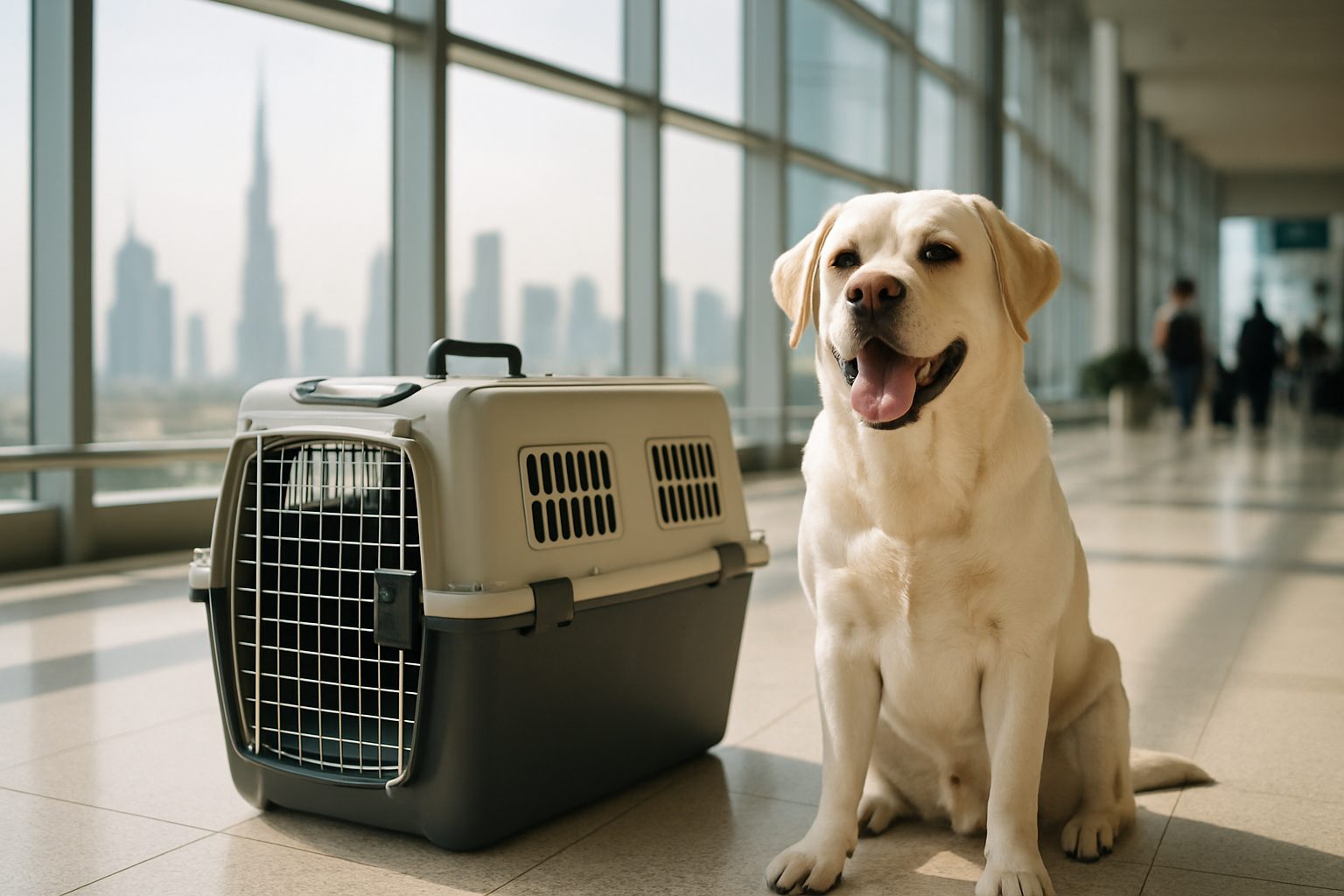
Relocating a dog is the most demanding kind of pet move, because dogs span a huge weight range, several breeds face UAE entry rules, and a number of popular breeds carry airline health restrictions. We coordinate every piece so nothing surprises you on travel day.
Dog relocation in Dubai covers two very different journeys. The first is local and regional transport — a climate-controlled, ground move within Dubai or between emirates such as Dubai to Abu Dhabi or Sharjah. The second is international relocation by air, either importing a dog into the UAE or exporting one out of it. Both depend on the same foundations: a compliant microchip, a valid rabies vaccination, a government health certificate and, for air travel, an airline-approved crate sized correctly for your dog.
We are a coordination service. We do not physically fly the animals ourselves; instead we connect you with vetted veterinary and transport partners, confirm your dog is eligible and ready, and make sure the paperwork, crate and flight all line up. For the wider picture across both species, see our main pet relocation in Dubai page. The sections below focus on what is specific to dogs: breed rules, crate sizing, snub-nosed and summer travel, the document timeline, and cost.
- Breed eligibility checks against the official UAE restricted-breed rules before you commit
- IATA-compliant crate sizing and sourcing through vetted partners
- Rabies vaccination and health-certificate timeline mapped to your travel date
- MOCCAE import or export permit guidance for moves to or from the UAE
- Flight and cargo coordination with dog-experienced airlines, including snub-nosed and summer rules
- Customs clearance at DXB or DWC and door-to-door delivery anywhere in Dubai
Dog Breed Eligibility
Before anything else, we confirm your dog can legally enter the UAE. The rules separate breeds into three groups, and the most common point of confusion is the difference between banned and restricted.
The UAE maintains an official list of dog breeds that are banned from import. These are typically breeds with a fighting or guarding lineage, such as the American Pit Bull Terrier, American Staffordshire Terrier, Tosa Inu, Dogo Argentino, Brazilian Mastiff (Fila Brasileiro), Japanese Tosa and certain wolf-dog hybrids. Crosses and mixes that include a banned breed are also refused. If your dog falls in this group, it cannot be imported, and no permit will be issued — so we check this first, before you spend on anything else.
Separately, there is a group of restricted breeds. This is the part owners most often get wrong: Rottweilers and Dobermans are restricted, not banned. They can be imported, but they may require additional conditions — such as a stronger, reinforced crate, additional handling arrangements, and in some cases extra documentation or local registration on arrival. Restricted simply means more requirements, not refusal. We tell you exactly which conditions apply to your dog so there are no last-minute problems at the airport.
A third group is the snub-nosed (brachycephalic) breeds, covered in their own section below. These are not banned or restricted by the government, but airlines apply their own health-based rules to them. For the full, current breed lists and the practical detail behind each group, read our banned dog breeds in Dubai guide. WhatsApp the breed only if you are ready to book a managed dog relocation and need eligibility confirmed against the official UAE rules.
- Banned — cannot be imported (e.g. Pit Bull-type breeds, Tosa Inu, Dogo Argentino, Fila Brasileiro and crosses of these)
- Restricted — can be imported with extra conditions (Rottweilers and Dobermans are in this group, NOT banned)
- Snub-nosed — eligible by law, but subject to airline health rules and crate upsizing
IATA Crate Sizing for Dogs
Air travel for dogs uses an airline-approved travel crate built to the IATA Live Animals Regulations. Choosing the right size is the single most important comfort and compliance decision you will make.
The crate must be rigid, well-ventilated on at least three sides, secured with metal bolts rather than plastic clips, and large enough for your dog to stand, turn around and lie down naturally. The standard sizing rule is that the crate height must clear the top of your dog’s head (or ear tips, for breeds with upright ears) with room to spare, and the length must comfortably fit the dog from nose to tail base plus its standing leg length. We help you measure your dog and match it to the correct IATA size code through our vetted partners.
- Measure your dog standing: A = nose to base of tail, B = floor to elbow, C = width across shoulders, D = floor to top of head (or ear tip)
- Crate length = A + half of B; crate height must be greater than D so the dog can stand without crouching
- Crate width = at least two times C so the dog can turn around comfortably
- Construction: rigid plastic or metal, metal bolt fasteners, ventilation on at least three sides, a solid leak-proof floor
- Fittings: water and food bowls fixed to the door, absorbent bedding, and clear live-animal labelling
- When a dog measures between two sizes, always choose the larger crate — and for snub-nosed breeds, go one size up as standard
Crate cost rises sharply with size, from a small carrier of around AED 150 to a heavy reinforced crate for a large or restricted breed, which is one reason large dogs cost more to relocate. We size the crate early so you can budget accurately and acclimate your dog to it before travel. For the full technical specification, see our IATA pet crate requirements guide.
Snub-Nosed Breeds & Summer Travel Rules
Two factors can ground an otherwise eligible dog: a snub nose and the Dubai summer. Both are about heat and breathing, and both are decided by the airline rather than the government.
Snub-nosed, or brachycephalic, breeds have shortened airways that make it harder for them to cool themselves and breathe under stress. Common examples include the French Bulldog, English Bulldog, Pug, Boxer, Boston Terrier, Shih Tzu, Pekingese and the Bullmastiff. Many airlines restrict or refuse these breeds in cargo, especially in hot weather, and most require the crate to be one size larger than normal to improve airflow. Some carriers ban them outright in the warmer months. We check the specific policy of each airline on your route before booking, so you are never caught out at check-in.
Separately, the Dubai summer drives embargo periods. From roughly May to September, ground temperatures on the tarmac and in airport holding areas can become dangerous for animals, and airlines impose seasonal restrictions on live-animal cargo — sometimes refusing all dogs, sometimes only snub-nosed or large breeds, and sometimes only on certain aircraft or routes. Workarounds include flying on temperature-controlled aircraft, choosing early-morning or late-night departures, routing through cooler hubs, or simply timing the move outside the embargo window. We plan around the season from the start so heat is never the reason your move is delayed.
- Snub-nosed breeds usually require a crate one size larger and may need a vet fitness-to-fly clearance
- Some airlines refuse brachycephalic breeds in cargo during summer; we confirm each carrier’s rule per route
- Dubai summer embargoes (about May to September) restrict live-animal cargo on heat-risk days
- Mitigations: temperature-controlled aircraft, night or early-morning flights, cooler transit hubs, or off-season timing
- For a deeper look at heat planning, see our pet travel in the Dubai summer guidance
Dog Vaccination & Document Timeline
Most relocation stress comes from timing, not paperwork itself. Vaccinations and tests have minimum waiting periods that cannot be rushed, so we map the whole calendar backwards from your travel date.
Every dog needs an ISO-compliant 15-digit microchip implanted before — or at the same time as — its rabies vaccination, because the rabies record must be tied to the chip number. A current rabies vaccination is mandatory and must usually be given at least 21 days before travel and still be in date. Dogs typically also carry core vaccinations such as DHPPiL. For dogs coming from countries the UAE classifies as high-risk for rabies, a rabies antibody titer test is required: the blood must be drawn at least 21 days after vaccination, show a result of at least 0.5 IU/ml, and the move can only happen after a further waiting period — which is what stretches some imports to around four months.
- ISO 11784/11785 15-digit microchip — implanted before or with the rabies shot
- Valid rabies vaccination — generally at least 21 days before travel and still in date
- Core vaccinations (DHPPiL) recorded in the vaccination booklet
- Rabies antibody titer test for high-risk countries — drawn 21+ days post-vaccination, result greater than or equal to 0.5 IU/ml, valid 365 days
- Government veterinary health certificate from the origin country, issued close to travel
- MOCCAE import permit (valid 90 days from issuance) for entering the UAE, or an export certificate for leaving
As a rough guide, a dog moving between two low-risk countries can often be ready in two to six weeks. When a titer is required, the blood sample must be taken within 90 days before travel and read at least 0.5 IU/ml — a sample window, not a wait after the draw. We build your exact timeline against your origin, destination and travel date, and verify every requirement against the current MOCCAE rules before you commit money to flights.
Dog Relocation Cost
Dog relocation cost is driven mostly by your dog’s size and the route. A small dog on a regional move sits at the bottom of the range; a large or restricted breed flying long-haul sits at the top.
Total dog relocation typically ranges from about AED 2,500 for a simple regional move to AED 22,000 for a long-haul flight with a large dog, a reinforced crate and full door-to-door service. The biggest single variable is air freight, which is priced on the combined weight of the dog plus its crate — so a large breed in a heavy crate costs far more to fly than a small one. Government permit fees are modest by comparison; most of your budget is veterinary work, the crate, the flight and coordination.
| Cost component | Typical range (AED) |
|---|---|
| MOCCAE permit + release fees | 450 – 700 |
| Veterinary (microchip, vaccines, health cert, titer) | 1,200 – 2,800 |
| IATA crate (small carrier to large reinforced crate) | 150 – 2,000 |
| Flight / cargo (size and route dependent) | 3,000 – 14,000+ |
| Coordination & door-to-door handling | 1,500 – 6,000 |
Snub-nosed surcharges, summer embargo workarounds and restricted-breed handling can add to the total, which is why we quote against your specific dog and route rather than a flat price. Send us your dog’s breed, weight, origin and destination on WhatsApp and we will return a clear cost range, usually within fifteen minutes during business hours.
Frequently Asked Questions
Official Sources
We coordinate the paperwork, but the rules are set by government and industry authorities. Always confirm the current requirements directly with the official sources.
Last verified: 6 September 2026. Confirm current figures on the official MOCCAE portal before you apply.
Ready to book a managed move?
WhatsApp during business hours with pet type, breed, route and month if you want us to run the file. Guides stay free to read.
Tell us about your moveGeneral guidance is free in the guides. Bespoke document review and coordination are paid.