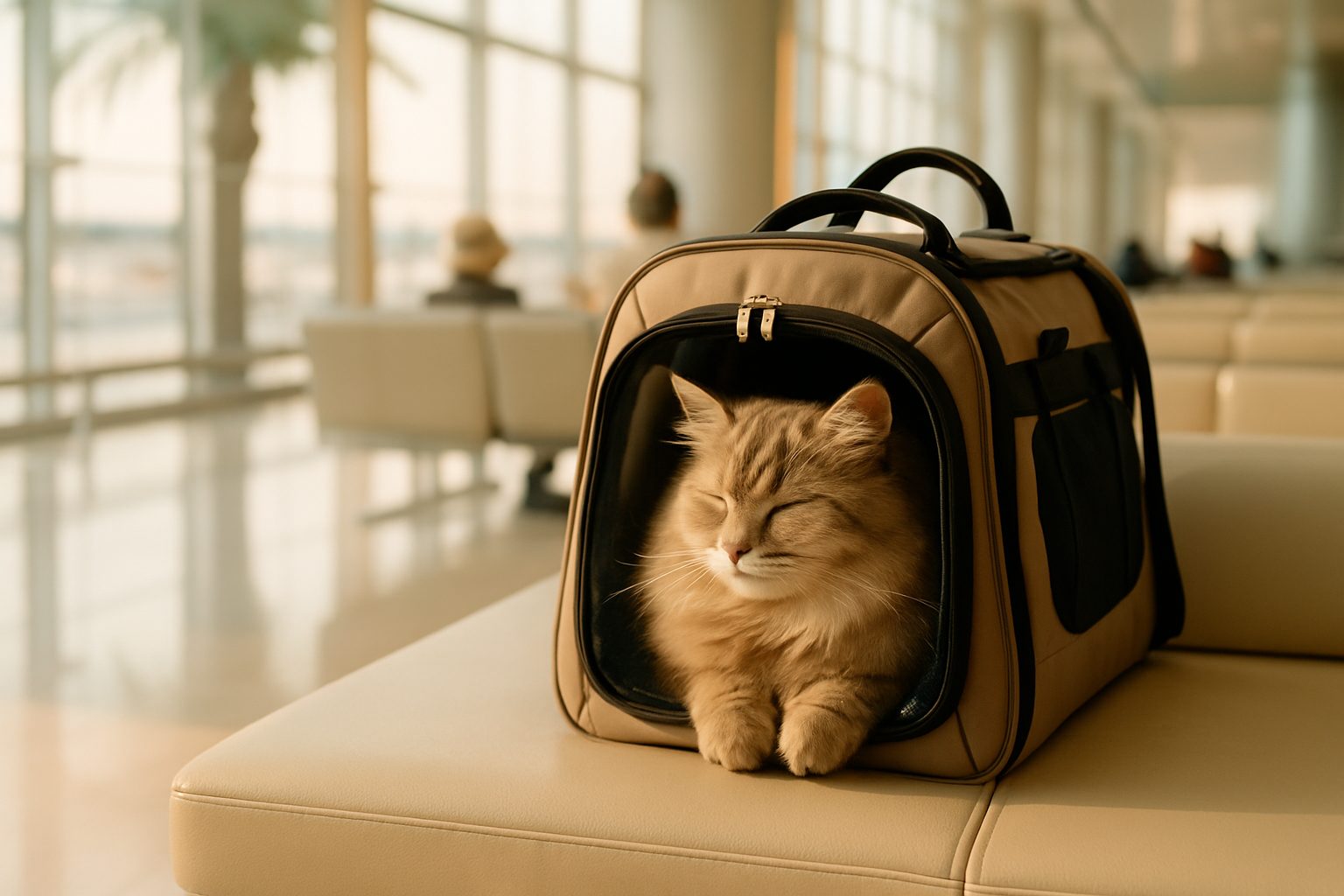
A calm cat inside an IATA-approved travel crate, ready for a safe journey to Dubai.

Updated June 2026

Cat Relocation

Cat Relocation to Dubai: Bringing Your Cat Home Safely

From pickup to reunion, we handle every step — clear pricing, honest answers, and WhatsApp updates at every checkpoint.

What Every Cat Owner Worries About (And Why You Don't Have To)

We understand the fears that keep cat owners up at night. Here is what we do about each one.

“My cat will be terrified the whole flight.”

Cats are sensitive creatures. They notice changes in routine, unfamiliar sounds, and new environments. The good news? Most cats handle air travel better than their owners expect. Cargo holds are climate-controlled, dark, and quiet — closer to a cosy cupboard than a loud cabin. We book morning flights to avoid heat and turbulence, and we only work with airlines that have proven cat-safe cargo protocols.

Before travel, we send you a guide to help your cat get comfortable with their crate — because familiarity reduces fear more than any sedative.

“My cat won't eat or drink during the journey.”

This is a common concern, and it's valid. Cats can be finicky about food and water in new situations. Here's what we do: We advise you to place a familiar-smelling item in the crate — a small blanket or toy from home. We ensure the crate has a spill-proof water container and a food tray attached to the door.

Most cats do eat and drink during long journeys, especially if they feel secure. If your cat has a special diet or medical needs, we coordinate with our vet partners to make sure those needs are met — and we tell the airline in writing.

“What if my cat tries to escape from the crate?”

IATA-approved cat crates are built for this. They have secure locking doors, reinforced ventilation openings, and no gaps large enough for a determined paw. We size the crate to your cat precisely — they should be able to stand, turn, and lie down, but not so large that they slide around.

A well-fitted crate is the safest place your cat can be during a flight. We check every latch ourselves before check-in.

“What if something goes wrong?”

This is the big one. What if the flight is delayed? What if there's a paperwork issue? What if your cat needs a vet mid-journey? Here's our answer: We plan for the problems before they happen. We double-check every document three times. We monitor flight status in real time. If a delay occurs, we have boarding partners at every major hub. And we WhatsApp you immediately — never leaving you to wonder.

In the rare event of a medical concern, our vet partners are on call at every stage. Your cat is never just “in the system.” We know exactly where they are, at all times.

How Cat Relocation to Dubai Works (Step-by-Step)

Every cat's journey is different, but the process follows a clear timeline. Here's what happens when you work with Dubai Pet Relocation.

1

Free WhatsApp Consultation (Day 0)

You message us. We ask about your cat's breed, weight, age, current location, and planned move date. We check for any route-specific restrictions or seasonal issues (like summer heat embargoes). Within 15 minutes, you'll know if your timeline is realistic and what the next steps are. No forms. No pressure.

2

Document Review & Veterinary Prep (Days 1–21)

We send you a cat-specific checklist. Your cat will need:

  • An ISO 11784/11785 microchip (implanted before any vaccinations)
  • A rabies vaccination (at least 21 days old before travel)
  • FVRCP vaccination (feline core vaccines)
  • An international health certificate (issued within 10 days of travel)

If your cat is already microchipped and vaccinated, great — we'll verify the dates. If not, we connect you with a vetted vet partner in your country who knows export requirements. Every certificate must show the same microchip number. We check this three times.

3

MOCCAE Import Permit (Days 14–21)

We apply for your cat's MOCCAE import permit online. This is a mandatory approval from the UAE Ministry of Climate Change and Environment. The permit costs AED 200 per pet and is valid for 90 days from issuance (a release fee of AED 250/cat is also payable on arrival). We handle the submission, track the status, and confirm approval — so you don't have to navigate the portal yourself.

4

Flight Booking & Crate Fitting (Days 21–28)

We book your cat's flight as manifest cargo — the only way cats can enter Dubai. We choose morning departures to avoid heat, and we confirm the airline's cat-specific policies in writing. We provide an IATA-approved travel crate sized to your cat, or we verify that yours meets standards. We label it correctly, attach feeding instructions, and include a familiar item from home if you provide one.

5

Final Health Check & Departure (Days 28–30)

Within 10 days of travel, our vet partner issues the international health certificate. We administer internal and external antiparasitic treatments within 14 days of arrival, as required by UAE law. We accompany your cat to cargo check-in, confirm they're loaded safely, and send you a photo before the flight departs.

6

Arrival in Dubai & Customs Clearance (Day 30+)

When your cat lands at DXB or DWC, we handle customs clearance immediately. Your cat is never left in a warehouse. We arrange prompt collection, a quick welfare check, and either airport handover or door-to-door delivery to your new home. We send you a photo the moment your cat is safely out of the crate.

7

Post-Arrival Registration (Within 30 Days)

We guide you through registering your cat with Dubai Municipality via the Aleef app. This is mandatory for all cats in Dubai. We also connect you with trusted local vets for a post-travel wellness check.

What Documents Does Your Cat Need to Enter Dubai?

Bringing a cat to Dubai requires specific paperwork. The rules are the same for all cats, regardless of breed or origin. Here's exactly what you need.

1

MOCCAE Import Permit

A mandatory approval from the UAE Ministry of Climate Change and Environment. Cost: AED 200 per pet (plus AED 250/cat release fee on arrival). Valid: 90 days from issuance. We apply for this on your behalf.

2

ISO Microchip (15-Digit)

Your cat must have an ISO 11784/11785 compliant microchip. This must be implanted before the rabies vaccination, and the microchip number must appear on every certificate. This is the most common paperwork error — and it's easily avoided with a single checklist.

3

Rabies Vaccination

Administered at or after 12 weeks of age. The vaccination must be at least 21 days old before your cat travels, and within 12 months of arrival. Only inactivated or recombinant vaccines are accepted — not live attenuated vaccines.

4

FVRCP (Core Feline Vaccines)

Your cat needs up-to-date core vaccinations: Feline Panleukopenia (FPV), Feline Rhinotracheitis (FHV-1), and Feline Calicivirus (FCV). Feline Leukemia (FeLV) is also recommended by most veterinary authorities.

5

International Health Certificate

Issued by an official or government-accredited veterinarian in your country of origin. This must be issued within 10 days of arrival in Dubai. It must include antiparasitic treatment records and show the same microchip number as all other documents.

6

Antiparasitic Treatment

Internal deworming (Praziquantel) and external treatment (Fipronil or equivalent) must be administered within 14 days of arrival. We coordinate this with our vet partner so the timing is exact.

7

Copy of Owner's Passport & UAE Visa

Required for the MOCCAE permit application and customs clearance. If you're not yet in Dubai, we can arrange for a representative to handle collection.

Good news for UK, EU, USA, Canada, Australia, and New Zealand owners: Your country is classified as low-risk for rabies. This means no rabies titer test (RNATT) is required, and the minimum timeline is just 4–6 weeks from start to finish. For high-risk countries, a titer test is required with a 90-day waiting period — so the timeline extends to 4 months minimum.

Important: Cats must be at least 4 months old to enter Dubai. If your kitten is younger, you'll need to wait or arrange temporary care until they reach the minimum age.

Are Any Cat Breeds Banned in Dubai?

No domestic cat breeds are banned

Unlike dogs, there are no domestic cat breeds banned from import into the UAE. Your Maine Coon, Siamese, Persian, Bengal, or mixed-breed cat is welcome — provided the paperwork is complete.

This is one of the reasons cat relocation is often simpler than dog relocation: no breed check anxiety, no restricted breed lists, and no community housing rules based on breed. As long as your documents are in order, your cat can enter.

One important restriction: wild cat hybrids

Wild cat hybrids are not permitted unless they are 5th generation or further removed from the wild pedigree. This includes early-generation Savannah cats (F1–F4) and early-generation Bengal cats (F1–F4).

If you have a later-generation Savannah or Bengal (F5 or beyond), they are treated as domestic cats and are permitted with standard documentation.

If you're unsure about your cat's generation status, we can help you verify. Just send us your cat's pedigree or registration documents via WhatsApp, and we'll confirm with MOCCAE before you book anything.

Not sure if your cat qualifies? WhatsApp us a photo and details

Choosing the Right Travel Crate for Your Cat

Your cat's crate is their home for the journey. It needs to be safe, comfortable, and compliant. Here's exactly what that means.

IATA Standards for Cat Crates

All cats entering Dubai must travel in an IATA-compliant crate. This means:

  • Rigid construction: Hard plastic or plywood with a solid roof and floor. No soft-sided carriers for cargo.
  • Secure door: Metal door with a locking mechanism that cannot be opened from the inside. The door must close firmly without gaps.
  • Ventilation: Openings on all four sides, covering at least 16% of the total surface area. For brachycephalic (flat-faced) cats like Persians or Exotic Shorthairs, the crate must be 10% larger than standard with increased ventilation.
  • No wheels: Wheels must be removed or locked.
  • Leak-proof floor: A solid, absorbent base that won't let moisture escape.
  • No top-opening lids: Cargo crates must open from the front only.
  • Proper sizing: Your cat must be able to stand upright without touching the roof, turn around easily, and lie down in a natural position. We measure your cat precisely.
A calm cat inside an IATA-approved travel crate, ready for a safe journey to Dubai.

Making the Crate Feel Like Home

A few simple additions make a big difference for cats:

  • A small, familiar blanket or item of your clothing: Your scent is comforting.
  • Absorbent bedding: A thin layer that won't bunch up. We provide vet-approved absorbent pads.
  • Spill-proof water container: Attached to the door, filled at check-in. We freeze water in the container for long flights so it melts gradually.
  • Food tray: Attached to the inside of the door with a small portion of dry food. We include written feeding instructions.

What About a Litter Box?

For long-haul flights (8+ hours), some owners ask if a litter box should be included. The honest answer: most cats will not use a litter box during a flight, even if one is provided. They're more likely to hold it.

For very long journeys with connections, we can arrange a comfort stop at a transit hub where your cat is taken out of the crate, offered food and water, and given a clean pad. We discuss this with you before booking.

Which Airlines Can Fly Your Cat to Dubai?

Cats entering Dubai must travel as manifest cargo — they cannot fly in the cabin or as checked baggage on flights to Dubai. There is one exception for Abu Dhabi, which we'll explain below.

Emirates SkyCargo (Most Common Route to Dubai)

Emirates is the primary carrier for cats arriving at Dubai International (DXB). Here's what you need to know:

  • No cabin or checked baggage: All cats must travel via Emirates SkyCargo.
  • Advance booking: Minimum 72 hours notice required. We handle this.
  • Documentation: We submit your cat's health certificate, crate photos, and the Owner Acknowledgement Form on your behalf.
  • Transit care: If your cat is in transit in Dubai for more than 6 hours, they're cared for at the Emirates Pet Lounge — a climate-controlled facility with trained staff.
  • ! Cost: Typically ranges from USD 1,500–5,000 depending on your origin country, route, and your cat's weight/crate size.
  • ! Breed restrictions: Emirates follows UAE federal rules. No domestic cat breeds are banned, but brachycephalic cats may have seasonal restrictions (November–April only) due to heat sensitivity.

Etihad Airways (Abu Dhabi Only — With In-Cabin Option)

Etihad is the most pet-friendly UAE airline, but with an important limitation: their in-cabin option is only for flights to Abu Dhabi (AUH), not Dubai.

  • In-cabin (PETC): Small cats (pet + carrier ≤ 8 kg) can travel in the cabin on flights to Abu Dhabi. Carrier max size: 40 x 40 x 22 cm in Economy. Fee: USD 399 per flight segment.
  • Cargo: Larger cats or those flying to Abu Dhabi via cargo.
  • ! Important: If you fly into Abu Dhabi, you'll need to arrange ground transport to Dubai (about 90 minutes). We can coordinate this for you.

flydubai & Other Carriers

flydubai handles pets as cargo through their cargo partners. Policies vary by route. We evaluate all options and book the safest, most direct route for your cat — not just the cheapest.

Cabin vs. Cargo: The Honest Truth for Cats

We get asked this often: “Can't my cat just fly in the cabin with me?” For Dubai, the answer is no — unless you're flying to Abu Dhabi on Etihad. But here's the honest truth: cargo is not worse for cats. In fact, for most cats, the dark, quiet, climate-controlled cargo hold is less stressful than a noisy cabin with strangers, rolling trolleys, and overhead lights. The key is the crate, the timing, and the handling. We control all three.

Should You Sedate Your Cat for Flying? (Honest Guidance)

This is the question that keeps cat owners up at night. And we have a clear, honest answer.

Most airlines and most veterinarians do not recommend sedating cats for air travel.

Here's why: Sedation affects a cat's ability to regulate their body temperature, balance, and breathing. At altitude, these effects are amplified. A sedated cat cannot adjust their position if they become uncomfortable, cannot respond to temperature changes, and may experience respiratory depression. The risk of adverse effects is real — and most airlines explicitly refuse to transport sedated animals.

What We Recommend Instead

A calm cat is a prepared cat. We help you reduce travel stress without medication:

  • Crate familiarity: Start crate training 2–3 weeks before travel. Feed your cat in the crate. Let them nap in it. Make it a safe space, not a signal that something scary is happening.
  • Feliway or calming pheromones: We recommend spraying the crate interior with a feline pheromone spray 30 minutes before departure. This is non-medicinal and widely used by vets.
  • Timing: We book morning flights. Cats are naturally more active at dawn and dusk; a morning departure aligns with their rhythm.
  • Direct routing: We avoid unnecessary connections. The fewer transitions, the less stress.
  • Hunger, not fasting: We do not recommend fasting cats before travel. A small meal 4–6 hours before departure is fine. Water should be available until check-in.

When Medication Might Be Appropriate

There are rare cases — extreme anxiety, medical conditions — where a vet may prescribe a mild anti-anxiety medication. If this is necessary, we coordinate with our vet partner to choose the safest option, at the lowest effective dose, and we inform the airline in writing.

We do not recommend this as a default. We recommend it only when a trusted vet says it's necessary.

The bottom line: Most cats travel calmly without sedation. Preparation beats medication.

Summer Heat, Long-Haired Cats, and Seasonal Planning

Summer Heat Embargo (June–September)

From June through September, most airlines impose heat embargoes on pet cargo. This means pets cannot be transported if the ground temperature at any point along the route exceeds 29.5°C (85°F). For Dubai, this effectively means:

  • June–August: Very limited cargo options. Some routes are suspended entirely.
  • May and September: Restricted — some routes available, some not.
  • October–April: Normal operations.

What this means for your cat:

If your move falls during summer, you have options. We can arrange:

  • Early morning or late evening flights on cooler days (when available)
  • Ground transport to a cooler origin hub for departure
  • Boarding with our vet partner until the embargo lifts
  • A pet travel nanny service (in-cabin escort on a passenger route, where permitted)

We will always tell you honestly if your timeline is realistic. We never book a flight we wouldn't put our own cat on.

Long-Haired and Flat-Faced Cats

Persian cats, Himalayan cats, and other long-haired or brachycephalic breeds need extra care in warm weather. Their shorter nasal passages and thicker coats make them more sensitive to heat. We take this into account when choosing:

  • Flight times (morning departures only)
  • Crate ventilation (increased airflow for brachycephalic cats)
  • Route selection (direct flights, minimal ground time)
  • Seasonal timing (if possible, we recommend October–April for these breeds)

If your cat is a Persian, Exotic Shorthair, or similar breed, we'll discuss these considerations with you before booking anything.

How Much Does Cat Relocation to Dubai Cost?

We believe in transparent pricing. Here's what you can expect, broken down by route and service level. Every quote we send is itemised — what you see is what you pay.

RouteEstimated Total (AED)What's IncludedNotes
UK to DubaiAED 8,500 – 12,000Permit, vet prep, crate, Emirates SkyCargo, customs, door deliveryNo titer test needed. Low-risk country. 4–6 week timeline.
USA to DubaiAED 10,000 – 15,000Permit, vet prep, crate, cargo booking, customs, deliveryNo titer test needed. Coast-to-coast routing varies.
India to DubaiAED 7,500 – 11,000Permit, vet prep, crate, cargo, customs, deliveryNo titer test needed. Short route = lower cargo cost.
Philippines to DubaiAED 9,000 – 13,000Permit, vet prep, crate, cargo, customs, deliveryNo titer test needed. Popular route.
Australia to DubaiAED 12,000 – 18,000Permit, vet prep, crate, cargo, customs, deliveryNo titer test needed. Longer distance = higher cargo cost.
High-Risk CountriesAED 11,000 – 20,000All of the above + rabies titer test + 90-day waitIncludes titer test (AED 500–1,200) and extended timeline.

What's Included in Every Dubai Pet Relocation Quote

  • MOCCAE import permit application and fees
  • Coordination with vetted veterinary partners for health checks and certificates
  • IATA-compliant travel crate (or verification of your own)
  • Flight booking as manifest cargo with a trusted airline
  • Customs clearance at DXB or DWC cargo terminal
  • Door-to-door delivery or airport handover in Dubai
  • WhatsApp updates at every stage (permit approval, check-in, boarding, arrival, customs clearance)
  • Post-arrival guidance for Dubai Municipality registration (Aleef app)

What Costs Extra (And We Tell You Upfront)

  • Rabies titer test (if required from a high-risk country): AED 500–1,200
  • Extended boarding if your timeline changes: AED 100–250 per day
  • Ground transport from Abu Dhabi to Dubai (if you choose Etihad in-cabin): AED 400–600
  • Additional pets: Each cat requires a separate permit and crate, though multi-pet discounts apply
  • Travel insurance (optional but recommended): AED 300–800 depending on coverage level

Why costs vary: The biggest variables are your origin country (cargo distance), your cat's weight and crate size, and whether a titer test is required. A small cat from India costs less than a large Maine Coon from Australia. We give you an exact quote — not a guess — after our first WhatsApp conversation.

What Cat Owners Say About Dubai Pet Relocation

“I was absolutely terrified about moving Oliver. He's not a brave cat — he hides when the doorbell rings. Dubai Pet Relocation sent me a step-by-step guide two weeks before travel, and we practised with the crate every day. On the day, they sent me a photo of Oliver at check-in, then another when he was loaded. When he arrived in Dubai, he was calm. A bit grumpy, but calm. He was eating within two hours. The team answered my WhatsApp messages at 11 PM. I never felt alone.”
SM

Sarah M.

Relocated from London to Dubai

“Mochi is a rescue cat with a history of anxiety. I was sure she'd need sedation, but the Dubai Pet Relocation team talked me through why that wasn't the safest option. Instead, we used a pheromone spray and her favourite blanket. They walked me through crate training over WhatsApp — literally sent me a video of how to do it. When Mochi landed, they sent me a video of her being taken out of the crate. She was alert, curious, and completely fine. The cost was exactly what they quoted. No surprises.”
PK

Priya K.

Relocated from San Francisco to Dubai

Frequently Asked Questions About Cat Relocation to Dubai

Verify With the Authorities

Official Sources

We coordinate the paperwork, but the rules are set by government and industry authorities. Always confirm the current requirements directly with the official sources.

Ready to Bring Your Cat to Dubai?

Your cat has been with you through every chapter. This move is just the next one. We'll make sure they get there safely, calmly, and with someone watching every step.

No forms to fill out. No hidden fees. Just a quick WhatsApp message to get started.

WhatsApp us about your cat

Or send us a photo of your cat, their breed, and your origin country. We'll reply within 15 minutes with a realistic timeline and an estimated cost range.

Your cat's journey. Made clear.

Dubai Pet Relocation — Dubai's transparent pet relocation coordination service. We guide you through MOCCAE import requirements. Vetted relocation partners. IATA compliant. Clear prices. Real humans. Safe pets.